Showing posts with label science. Show all posts

Saturday, April 3, 2010

Belated Ice Worries

This should have been posted 2 months ago, but we noticed, in the really cold weeks of January, that we had some weird fortress-of-solitude type crystal growth emerging from the turf. Odd, yes? Hoary gelid stalagmites. (You can always remember that stalagmites push up from the ground mightily, while stalagtites hang tight to the ceiling).


The ground between the house and the air conditioning unit is pretty much a cesspool. It's always very wet due to the condensation drainage from the outside unit and a drain pipe from the inside unit. I'm guessing that's what caused this.

A few weeks ago, after the thaw, I dropped a socket wrench from 3 feet, and the thing sank into the muck up to the head. Looked exactly like this:


We've put in a splashpad to redirect some of the moisture away from the foundation, but that won't change the fact that we live in the swamps of sadness. But, you know, happier.

Sunday, November 1, 2009

Our deadliest catch

We dug a new flower bed this weekend. Why? Because gardening is cheap entertainment. While digging up turf and cultivating the soil, we dug up a deadly little visitor. Ladies and gentlemen, I give you a millipede of the genus apheloria...


This thing is about the size of my index finger.
 

I was curious what all the day-glow orange was about. Isn't that nature's way of indicating friendliness? No wait, it indicates danger.

After a quick google, it appears that the aphorelia millipede, when threatened, emits a cyanide compound from its flanks. ITS FLANKS. Was this millipdede designed by the KGB? Sarah Moyer notes that

Apheloria corrugate is a chemistry marvel. It produces hydrogen cyanide (HCN). HCN, also known as cyanide, is a well-known poison that once inhaled will compromise the respiratory processes on a molecular level and in high enough doses result in death.

Storage of the HCN is a slightly complicated task. Since HCN is a gas at room temperature and could harm Apheloria corrugate if they stored it as HCN, their bodies are designed to store it in a special way. On both sides segments 5,7,9,10,12,13, and 15 to 19 of its body, they have two different chambers that each contain a different chemical that produce HCN when they are mixed.

When they want to defend themselves, they release the first chemical (mandelonitrile) from its storage chamber into the reaction chamber that contains an enzyme (benzoyl cyanide). Once these mix, they produce benzoic acid and HCN. It secretes from glandular pores located on each side of 11 segments of its body. They produce droplets that stay attached to the gland opening. Shortly after they secret HCN, the smell of bitter almonds will surface which will kill most of their enemies.

An adult Apheloria corrugate can produce as much as 0.6 milligrams of HCN. This is enough to kill ants and deter many of their other enemies. It's 6 times the lethal dose of a 25-gram mouse and 0.01 times the lethal dose of a human.

OK OK, so maybe .01x the lethal dose isn't technically deadly (unless you put 100 of the millipedes in your mouth, which is a remote possibility in this house), nevertheless, apparently the HCN is enough to make a person fairly ill. So yeah, we threw it over the fence into the backyard. Oops.

Thursday, October 29, 2009

My nectarshake brings all the insects to the yard

A few weeks ago, we got fed up with the bland and generic shrubberies in the front yard. Well, we like the shrubberies just fine. They are healthy and relatively symmetrical, so we have no objection there. But the Ms. wants flowers and color. Quoth the Ms.: "Color is what makes me go 'woo'."

So, we we found some of these awesome purple coneflowers, a.k.a echinacea purpurea, and put them in between the shrubs. Coneflowers are like the redneck cousins of daisies. They're wildflowers, and not as popular in gardens because of their big orange seedheads.


We quickly noticed, within 30 minutes of planting them, that local bees (I assume they are local and not out of towners) were big fans. Well, it IS autumn, and there's not a lot of pollen to be had. I wonder if the bees would love us so much if it was Spring. Here's a bee making overtures to our new plant.


 Well, yesterday we were swarmed with butterflies as well.


I think there are 4 butterflies and 2 bees on this one slutty plant.

Traditionally, Echinacea was used to help heal insect bites, diphtheria, typhoid, blood poisoning, and other diseases such as tuberculosis that affect the body's immune system. The American Botanical Council states that "Echinacea may be of value for any infection, chronic or acute, but especially where there is not long-term immune deficiency or dysfunction." (Herbalgram #30 supplement, 1994).

But I think they're too attractive to eat, and the insects have apparently called dibs.

Tuesday, October 27, 2009

Dawkins made me mulch

Problem: The area of our backyard under the roofline has been eroded by rainwater pouring off the roof. The result is a ditch about 8 inches lower than the turf level, filled with sand and rocks.  It reminds me of a neat story...

Richard Dawkins uses the example of how the force of pounding surf, given enough time, will eventually sort all the rocks on a beach, tossing the lighter rocks farther up the shore, and leaving the heavier rocks closer to the water. To the passing observer, it would seem that this order and organization in nature must be the result of intelligence. But no, it's just physics.

So, that's what I was thinking of when I saw this ditch full of sand and pebbles. Then I realized the ditch was ugly, possibly dangerous to the foundation, and Dawkins is a shrill and bitter man.

So, what to do? Probably the smartest thing to do would be to install gutters. I've got them in front, why not in back? But that seems complicated (it probably isn't), plus I don't own a ladder. Well, why not dig a flower bed next to the house and fill it with an assortment of shrubberies? Yay! New project!


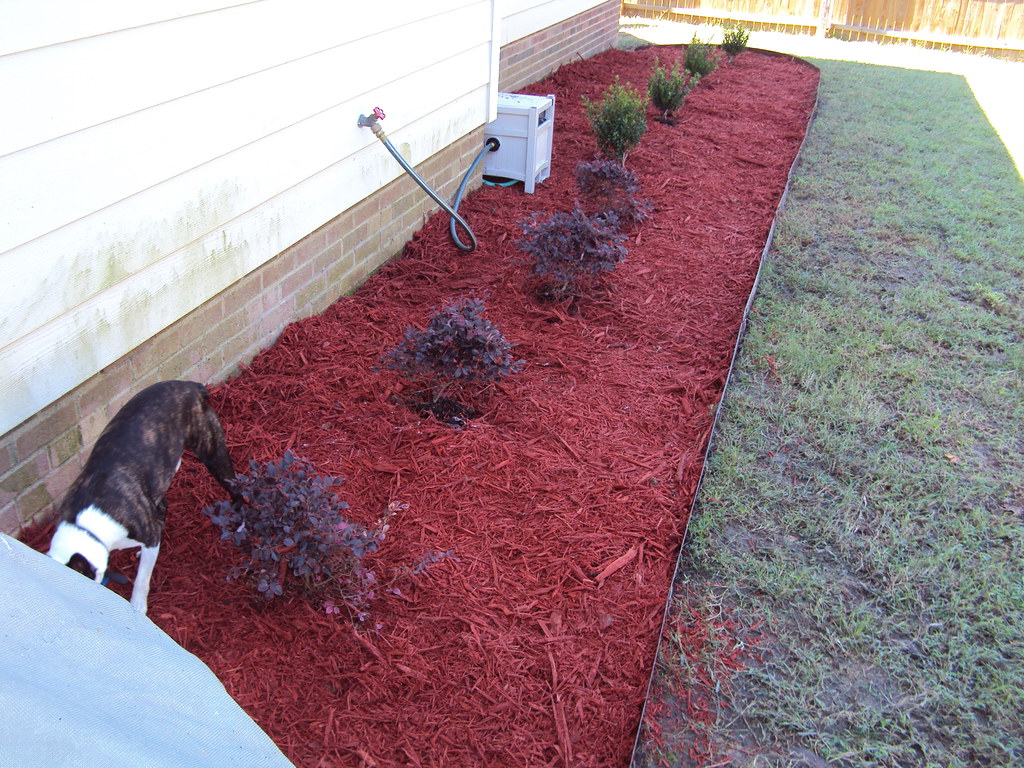
First, chop up the earth, mix the tough clay with topsoil and compost, and level everything out. No toads were harmed during this project. Several, however, were relocated aerially over the fence.


Look at all the red Carolina clay. Fun fact: the clay turns red because of a complete lack of aerobic bacteria. It suffocates life! Normal soil particles are irregular shaped, and allow moisture and air to flow between them. Clay is made of flat plates that lock together forming a nearly impermeable barrier. Jerks. Hopefully, by amending the soil with compost, we will break up the consistency a bit.


Next, we plant! For this bed, we decided on a mixture of Japanese Box Hollies and Purple Diamond Fringebush. Both will only get to be 4'-6' and do not require full sun.

The Ms. and her sharp instruments of agri-wonder:


With shrubs planted, it's time to mulch. I've never lived in a place with red mulch. Always brown. Well, I'm an adult now, and I'm getting red mulch.


Maybe the red doesn't set off the purple fringebush as well as a tan mulch would. Oh well, too late now. I had already bought nearly 30 cubic feet of the stuff. (nb: When guesstimating how much mulch you will need, go ahead and multiply your first guess by like 11, and save yourself a couple of trips to Lowe's).


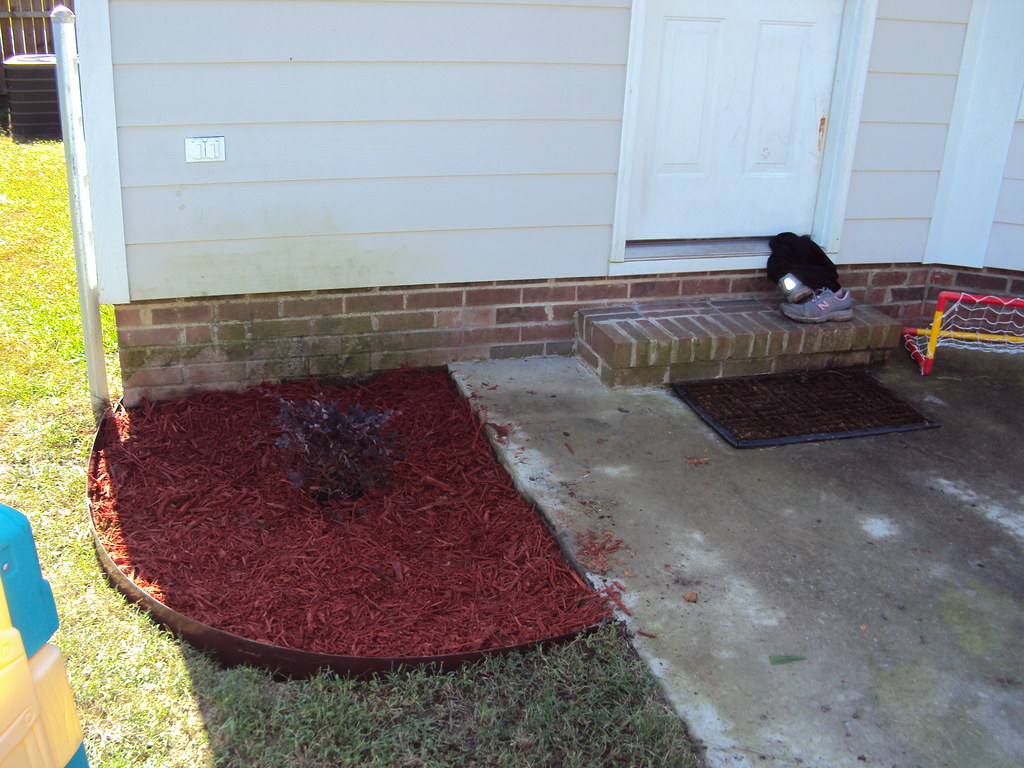
The finished product:


It didn't occur to us until after the whole job was done that the new flower bed, on the North side of the house, gets absolutely no direct sun. Check back in a year to see if these plants make it!

My hypothesis is that the combination of mulch, shrubs, and flower bed borders will thwart the erosion of both my topsoil and the credibility of robust divine action.

Trees: Round 1

Our first priority were trees. We have quite a bit of space to work with in the side and front yards. We decided to go with two to begin with.

For the front, I wanted lots of color, and maybe something flowering. I probably should have done more research, but I got impulsive, and just picked up a couple of trees from the local Lowes.

First, a Yoshino Cherry. Now, I'd never planted a tree before, so here it goes...


Our soil is a mixture of sand and clay. Mostly clay.


The Cherry tree will eventually look like this (in Spring):


Also planted an Autumn Blaze Maple,


which will eventually look like this (in Fall):


For now, however, the trees are babies, and it kind of looks like we've planted sticks in our yard.